Showing posts with label Performance Management. Show all posts

03 March 2020

02 March 2020

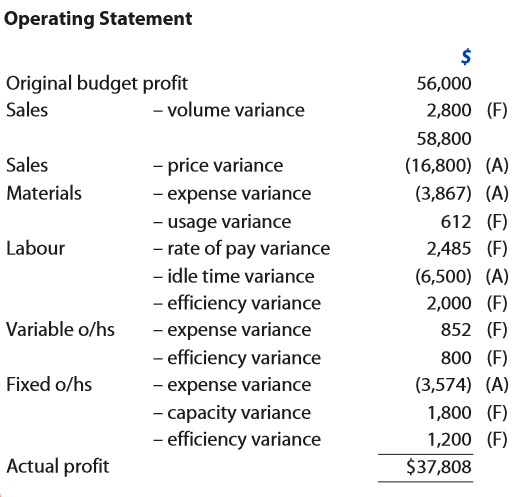
ACCA PM Chapter 13 - STANDARD COSTING AND BASIC VARIANCE ANALYSIS

Total Variances


Possible reasons for Adverse Materials

Expenditure Variance:
  • Price Increase
  • "Bad Buying"
  • Mistake in Budgeting
  • Deliberately decided to buy better material which costs more
    • To reduce waste -> favorable usage variance
    • To produce faster -> favorable efficiency variance
  • Make better products
    • Sell More -> favorable sales volume
    • Increase Selling Price -> favorable price variance.


The idea of variances affecting one another is called the Interrelationship of Variances.


Source: https://opentuition.com/acca/pm/acca-performance-management-pm-lectures/

ACCA PM Chapter 12 - QUANTITATIVE ANALYSIS IN BUDGETING

High Low Method

Learning Curve

Formula

Workings (a):

Workings (b):

Workings (c):


ACCA PM Chapter 11 - BUDGETING


Benefits of budgeting

  • Planning
  • Co-ordination
  • Control
  • Authorizing and delegating
  • Evaluation of performance
  • Communicating and motivating


Principal budget factor
The principal budget factor is the factor that limits the activity for the budget period. Usually, the limit is on the sales level. Sometimes, it could be a limit on the availability of raw materials that limit the activity.

A series of budgets is called a functional budget.


Types of budget:


  • Fixed Budget

    • Original Budget prepared (Usually for the next year)
    • Rapidly goes out-of-date
    • May update periodically.
    • Remains Overall Target.

  • Flexed Budget

    • Rewrite the budget for the actual level of activity.
    • Use it for Control purposes (Compare Actual with Flexed)


  • Rolling Budget

    • Dec07: Jan08-Dec08
    • Jan08: Feb08-Jan09
    • Feb08: Mar08-Feb09
    • Each Month: Update the existing 11 months and add an extra month.
    • Benefits:
      • Always more up-to-date
      • Becomes part of normal work
        • Better budgets

Methods of Budgeting

  • Incremental budgeting
    • Take last year's figures and adjust, for inflation, for changes in the level of activity.
  • Zero-based budgeting
    • List alternatives available
    • List out and choose best
    • Then prepare budgets.
    • Problem:
      • Time-consuming/Expensive
      • Need expertise/Training/Involvement
    • Solution:
      • Identify the most important area each year, use zero-based.
      • use incremental on the rest.

Behavioral Aspects:

  • Top-Down
    • Prepared by top management
  • Bottom-Up
    • Managers prepare budgets
    • Managers more motivated
    • Dangers: Managers budget more than needed - budget padding.
"Beyond Budgeting"
Comparing to last year's figures and budgets is meaningless. Consider not doing budgets at all but finding other ways to compare departments, perhaps even comparing with another company.


Source: https://opentuition.com/acca/pm/acca-performance-management-pm-lectures/

01 March 2020

ACCA PM Chapter 10 - RISK AND UNCERTAINTY

First, construct a matrix/table.


Maximin - Risk Avoider


Maximax - Risk Seeker


Minimax Regret - Risk Avoider


Expected values - Risk Neutral

Limitation:

  • Accuracy of probabilities.
  • Only valid for repeated occurrences.


Perfect Knowledge

Decision Trees


Source: https://opentuition.com/acca/pm/acca-performance-management-pm-lectures/

28 February 2020

ACCA PM Chapter 9 - SHORT-TERM DECISION MAKING - Relevant Costing | Make or Buy decisions


Relevant Costing

Incremental Costs mean extra, or additional costs - Relevant Costs.

Opportunity Costs -The value of a benefit sacrificed / Lose Contribution / Losing Income - Relevant Costs.

Sunk Costs - Already spent money - Not Relevant Costs.

Committed Cost - Not yet pay but will have to pay whether we do the contract - Not Relevant Costs


Make or Buy decisions

Where resources are limited, the firm should concentrate on making those products that give the greatest saving (over buying in) per unit of the scarce resource.

  1. Calculate Savings per unit if we make ourselves.
  2. Define the measurement (kg) of material
  3. Calculate Savings per material (kg). To determine which saves more by order.
  4. Finally, Calculate,
    • which and how many products should the company make?
    • which and how many should it buy?

23 February 2020

ACCA PM Chapter 9 - SHORT-TERM DECISION MAKING - Shutdown Problems

Shutdown Problems


Calculate the effect on current profit to decide whether or not to close part of the business:

Stop Product A:
  • Lose Contribution: (15000)
  • Save Fixed Costs:  5000
Do Product B:
  • Extra Contribution: 20000
  • Extra Fixed Costs: (6000)
Effect on Current Profit: +4000


In conclusion, we should stop Product A and do Product B.

16 February 2020

ACCA PM Chapter 8 - COST VOLUME PROFIT ANALYSIS

Breakeven

Breakeven volume = Fixed costs / Contribution per unit.


Margin of Safety

Margin of Safety = (Budgeted sales - breakeven) / Budgeted sales x 100%


Contribution to Sales ratio

C/S ration = Contribution in $ / Sales in $


Breakeven Chart


Profit-Volume chart


Multi-Product CVP analysis
A company may produce several products, each with different CS ratios. The company could reach the breakeven position sooner if it were to sell the product with the highest CS ratio first.


Limitations of CVP analysis

  • The selling price per unit is assumed to remain constant at all levels of activity
  • The variable cost per unit is assumed to remain constant at all levels of activity
  • It is assumed that the total fixed costs remain constant
  • It is assumed that the level of production is equal to the level of sales (o.e. that there are no changes in the levels of inventory)

ACCA PM Chapter 7 - PRICING - Pricing strategies

Pricing strategies

Penetration Pricing
Charge low prices to gain market share with the intention of increasing later. (Example: Chocolate)

Price Skimming
Charge high price at first, reduce over time. (High-Tech).

Product-Line Pricing
Different versions of the same product at different prices. (Example: Cars)

Complementary Products
Example: Razor; holder (Free) and blades (Expensive).

Price Discrimination
Sell the same product to different markets at different prices.
Examples:
Coffee: Europe $10; Africa $6
Bus Ticket: Adults $5; Children $2

Volume Discounting
Give discount for large quantities.

Source: https://opentuition.com/acca/pm/acca-performance-management-pm-lectures/

15 February 2020

ACCA PM Chapter 7 - PRICING - Optimal pricing – equations

Price\Demad Equation

P = a - bQ
where,
P = Selling Price
Q= Quantity Demanded at that Price
a= Theoretical Maximum Price. (The demand will be zero)
b= the change in price required to change demand by 1 unit (Gradient)


Optimum Selling Price


Steps:
  1. Establish the demand function; (find a and b); b = change in price/change in quantity
  2. Establish the marginal cost; Fixed overheads are ignored as they are not part of the marginal cost.
  3. Establish the marginal revenue function: MR = a - 2bQ; using MC = MR.
  4. Solve the MR function the determine the optimum quantity, Q.
  5. Insert the value of Q from Step 4 into the demand function determined in step 1 and calculate the optimum price.
  6. Calculate profit; (Revenue - Variable costs - Fixed costs = Profit).

Source: https://opentuition.com/acca/pm/acca-performance-management-pm-lectures/

10 February 2020

ACCA PM Chapter 7 - PRICING - Optimal pricing – tabular approach


Optimal pricing – tabular approach

- Sometimes it is worthwhile to reduce the selling price and sell more if this resulted in a higher total profit.


Price elasticity of demand (PED) =

 % change in demand
---------------------------
   % change in price


Source: https://opentuition.com/acca/pm/acca-performance-management-pm-lectures/

19 January 2020

ACCA PM Chapter 7 - PRICING - Introduction, Cost plus pricing

Factors influencing selling price:

  • costs
  • competitors
  • customers


Cost-plus pricing

1. Full cost plus - Full cost includes a shared overhead and also often includes non-production costs.

Advantages:

  • Easy
  • Standard Policy
  • "Guaranties" Profit


Disadvantages:

  • Ignores Competition
  • Ignores Effect of Price on Demand
  • Absorption of Fixed Overheads


2. Marginal cost plus - the marginal (or incremental) cost of producing a unit and adding a mark-up.

Advantages:

  • Easy
  • Standard Policy
  • No need to absorb Fixed Overheads


Disadvantages:

  • Ignores Competition
  • Ignores Effect of Price on Demand
  • What % to add to make sure Fixed Overheads covered?


3. Opportunity cost plus - a marginal cost approach but also includes within the cost any opportunities foregone. It is a relevant costing approach.


Source: https://opentuition.com/acca/pm/acca-performance-management-pm-lectures/

15 January 2020

ACCA PM Chapter 6 - Limiting Factors

Linear Programming
  1. Define the unknowns in terms of symbols
  2. Formulate equations for the constraints
  3. Formulate an equation for the objective
  4. Graph the constraints and the objective
  5. Find the optimum solution


Spare capacity
If the optimum solution results in using less than the maximum available of a particular resource, then we have spare capacity of that resource or slack.

Shadow prices (dual price)
Shadow Price is the most EXTRA we would be prepared to pay for an extra unit of the limited resource.


13 January 2020

ACCA PM Chapter 5 - Key Factor Analysis VS Throughput Accounting

Key Factor Analysis

Contribution = Selling Price - Variable Costs.
Contribution = Profit before Fixed Costs.

Contribution per hour = Contribution / hour

Fixed Costs,
(Assume that original costings were done before knowing about the limit on hours - produce to equal demand)

Contribution - Fixed Costs = Maximum Profit.


Throughput Accounting

Assume the ONLY Variable Cost is Materials.
(ALL Other Costs fixed in total).

Throughput = Revenue - Material Cost.

Return per factory hour = Throughput per hour.

Fixed Costs,
(All Costs other than Materials).
Throughput - Fixed Costs = Maximum Profit.

Total factory costs = all production costs except materials

Cost per factory hour = Total factory costs / Available hours

Throughput Accounting Ratio = Return per factory hour / Cost per factory hour.


Bottleneck

The rate of production will be restricted by the slowest of the machines, and this machine is known as the bottleneck resource.


Source: https://opentuition.com/acca/pm/acca-performance-management-pm-lectures/

11 January 2020

ACCA PM Chapter 4 - Environmental Management Accounting

1. The focus is to on the efficient use of resources and the disposal of waste and effluent.

2. Three ways of impact in environmental costs.
  • Cost on excessive resources and cleaning-up.
  • Reputation pf the company.
  • Fines and penalties.

3. Typical environmental cost, other than waste.
  • Raw Materials: Use recyclable material to save costs.
  • Transport Costs: Find alternatives.
  • Water and Energy consumption: Identify inefficiencies and wasteful practice to save costs.

4. The Accounting method for environmental costs.
  • Inflow / Outflow analysis
    • All waste in Raw materials as well as energy and water.
  • Flow Cost Accounting
    • Material (Not Raw)
    • System
    • Delivery and disposal
  • Lifecycle costing
    • Design-out the cost before the product launched.
  • Environmental Activity-Based Costing
    • Environment-related cost (E.g., Sewage plant)

07 January 2020

ACCA PM Chapter 2 - Target Costing

Target Cost is the maximum cost per unit in order to achieve the required profit.

It is used to compare the estimated actual cost. The excess of the actual cost over the target is called "Target Cost Gap".

Possible ways of attempting to close the target cost gap:

  1. Examine costs to look for cheaper.
  2. Reexamine design of the product, can we reduce cost without needing to reduce the price.


The five major characteristics that distinguish services from manufacturing are:

  1. Intangibility
  2. Inseparability / Simultaneity
  3. Variability / heterogeneity
  4. Perishability
  5. No transfer of ownership

04 January 2020

ACCA PM Chapter 1 - Activity Based Costing

Overheads = Expenses

In ACCA F2, we probably used only one cost driver (e.g., labor hours) to calculate costs.

Activity-Based Costing (ABC) attempts to absorb overheads in a more accurate (and therefore more useful) way.

The steps to be followed are as follows:
  1. identify the major activities that give rise to overheads (e.g., machining; dispatching of orders)
  2. determine what causes the cost of each activity – the cost driver (e.g., machine hours; the number of dispatch orders)
  3. calculate the total cost for each activity – the cost pool (e.g., total machining costs; total costs of despatch department)
  4. calculate an absorption rate for each cost driver
  5. calculate the total overhead cost for each product manufactured
  6. calculate the overhead cost per unit for each product

01 January 2020

Intro to ACCA F5 - Performance Management

PM Syllabus
  • Costing techniques
  • Decision-making techniques
  • Budgeting and control
  • Performance management
The Exam
Section A - 15 x 2 marks
Section B - 3 Scenarios x 5 x 2 marks
Section C - 2 x 20 marks.

Computer-based
  • 3 hours 20 minutes
  • Sections A and B - all objective test questions
    • Extra 5 questions (2 marks each) do not count towards the overall mark.
  • Section C - type out full answers using the built-in spreadsheet and word processor
  • Pass mark - 50%

Credit to:

Open Source Information Gathering using Windows Command Line Utilities

 How to Find the Maximum Frame Size Packet needs to be fragmented but DF set, means that the frame is too large to be on the network and ne...